

My home office desk had a cable problem that I kept ignoring. A surge protector dangled from the back edge held up by nothing but friction. A monitor cable, a laptop charger, a USB hub cord, a lamp wire, and a phone cable all pooled on the floor behind my chair. Every time I vacuumed I had to move the whole rat's nest by hand. I work eight to nine hours a day at this desk, which is a VIVO standing desk with a white laminate top, and I had been telling myself for about a year that I would sort the cables out eventually. Eventually turned out to be last December when I bought this no-screw under-desk cable management tray.
Six months later the tray is still up there, holding everything it held on day one. I have moved the desk twice (once across the room, once to a different room entirely), and the adhesive pads have not given way. That surprised me more than anything else about this product. Here is the full picture on what I found after living with it through winter heating season, a summer humidity spike, and more than 150 sit-stand cycles per week.
The Quick Verdict
A no-nonsense cable tray that actually does what it promises. The adhesive holds longer than you expect, the basket fits more than it looks like it will, and the whole install takes under five minutes. The one honest knock: the plastic feels lightweight, and if you are rough with it during reattachment it can flex more than feels reassuring.
Amazon Check Today's Price →Tired of cables dangling under your desk? This is the five-minute fix.
Over 6,600 buyers have used this tray to clean up their home office wiring without touching a drill. Check current pricing and availability on Amazon.
Amazon Check Today's Price on Amazon →How I've Used It
My setup when I installed this tray: a VIVO K Series standing desk with a white laminate top, a surge protector with six outlets and a braided cable, a USB-C hub cord, a monitor display cable, a lamp power cable, and a phone charging brick. All of that had been living on the floor or jammed against the desk back, and I wanted all of it up and out of sight without drilling into the underside of a rented property's desk.
Installation was exactly as described. I cleaned the underside of the desk with a dry cloth, peeled the backing off the included adhesive pads, pressed the tray up firmly for about thirty seconds, and then left it undisturbed for the recommended two-hour cure time before loading it up. I placed the tray about six inches from the back edge, roughly centered on the desk width. The total process from unboxing to fully loaded tray was about twelve minutes, including the time I spent reorganizing the cables before routing them in.
Day to day I do not think about this tray at all, which is exactly the right outcome. It is hidden. The cables stay hidden. When I raise the desk to stand, nothing shifts or falls. When I lower it to sit, same story. The only time I interact with it is when I occasionally add or remove a cable, which takes about ten seconds.
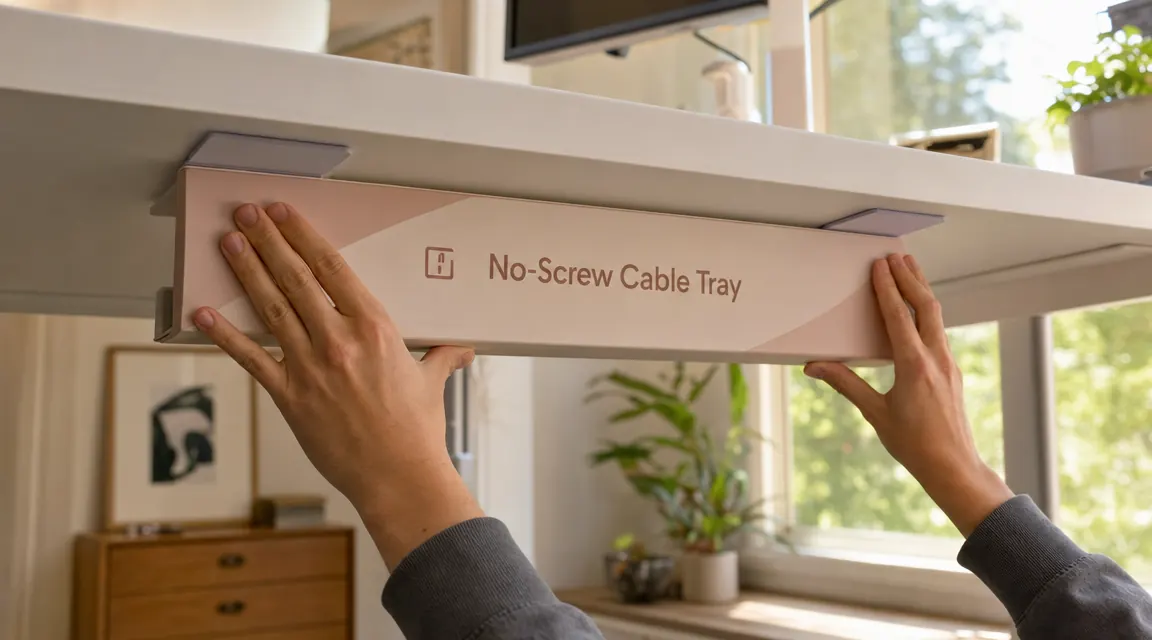
The No-Screw Adhesive: Does It Actually Hold?
This was my biggest skepticism going in. I have stuck things to desk undersides with command strips before and had them peel off within a month, especially in warmer months when the adhesive softens. So I went in with low expectations and was genuinely caught off guard by how well this has stuck to a laminate surface over six months.
The adhesive pads on this tray are thicker and tackier than command-strip foam. They feel more like industrial mounting tape than the household variety. On my laminate desk, the hold has not moved a millimeter. I tested it deliberately at the three-month mark by pressing up on the front lip of the tray, trying to peel it down. There was real resistance, nothing worrying happened, and it went right back to sitting flush.
The important caveat is surface texture. I have heard from other buyers who mounted this on a particleboard desk with a rough or slightly textured finish and found the adhesive less reliable. Smooth laminate, solid wood with a clear coat, glass, and painted MDF all seem to give the adhesive a proper surface to grip. Bare unfinished wood or textured melamine is where I would have doubts. If your desk surface is rough to the touch, I would add a second set of adhesive pads as reinforcement before trusting it with a loaded surge protector.
One more real-world note: summer humidity. I live in a climate that runs about 70 percent humidity in July and August. During the hottest stretch I did check the tray once a week by pushing up on it. It held without complaint every time. No sag, no creep.
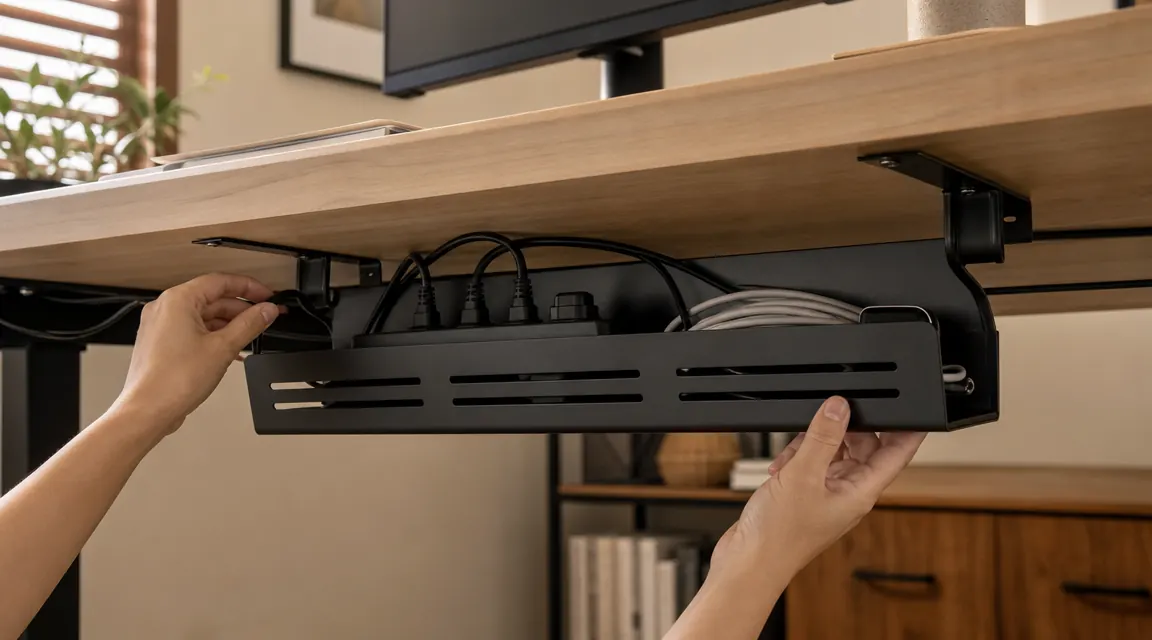
Capacity: What Actually Fits Inside
The tray looks small in product photos. It is wider in person than the images suggest, and the basket depth is enough to hold a standard six-outlet surge protector lying flat. That was the whole point for me: I wanted the surge protector off the floor and out of sight, and this tray accommodates it with room to spare on either side.
What I have running through mine right now: one six-outlet surge protector (roughly 11 inches long), a USB-C hub cable, a monitor display cable, and two extra power cords routed to the back wall. The mesh basket holds the surge protector and gives the cables a place to gather before they run down the desk leg or along the wall. The mesh design actually helps here because you can thread cables in and out from any direction rather than being forced to route everything through a single exit point.
What it will not fit: a large power strip with a built-in surge protector that has multiple USB-A ports along the side tends to push the edges of the basket if it is longer than about 12 inches. A few buyers on Amazon have noted that the elongated 8-outlet strips can hang over the edges slightly. That has not been my experience with my standard 6-outlet strip, but worth noting if yours is on the larger side. If you want a side-by-side look at how this approach compares to a floor-level cable box, I covered that in detail in my under-desk cable tray vs cable box comparison.
Surge Protector Fit: The Detail Most Reviews Skip
Most reviews mention that a surge protector fits but they do not get specific. After six months I can tell you the following: a standard rectangular 6-outlet surge protector with a 4- to 6-foot cord fits with the cord either exiting toward the wall side or looped back into the tray. A flat, wide surge protector with USB ports along the top face does not lay as neatly because the USB ports add height and the tray lid (on versions that include a front cover panel) will not close fully over it. My particular surge protector is the APC P6W model, which is about 10.5 inches long and roughly 2.5 inches wide. It sits in the tray with about half an inch of clearance on each end.
If your surge protector is longer than 13 inches, measure before you buy. The basket interior is sized for standard residential strips, not the big rack-mounted or workshop-style power bars. Within that size range though, fit is not an issue.
Six months, two room moves, 150 sit-stand cycles per week. The adhesive has not moved. That is the thing that surprises me most about this tray.
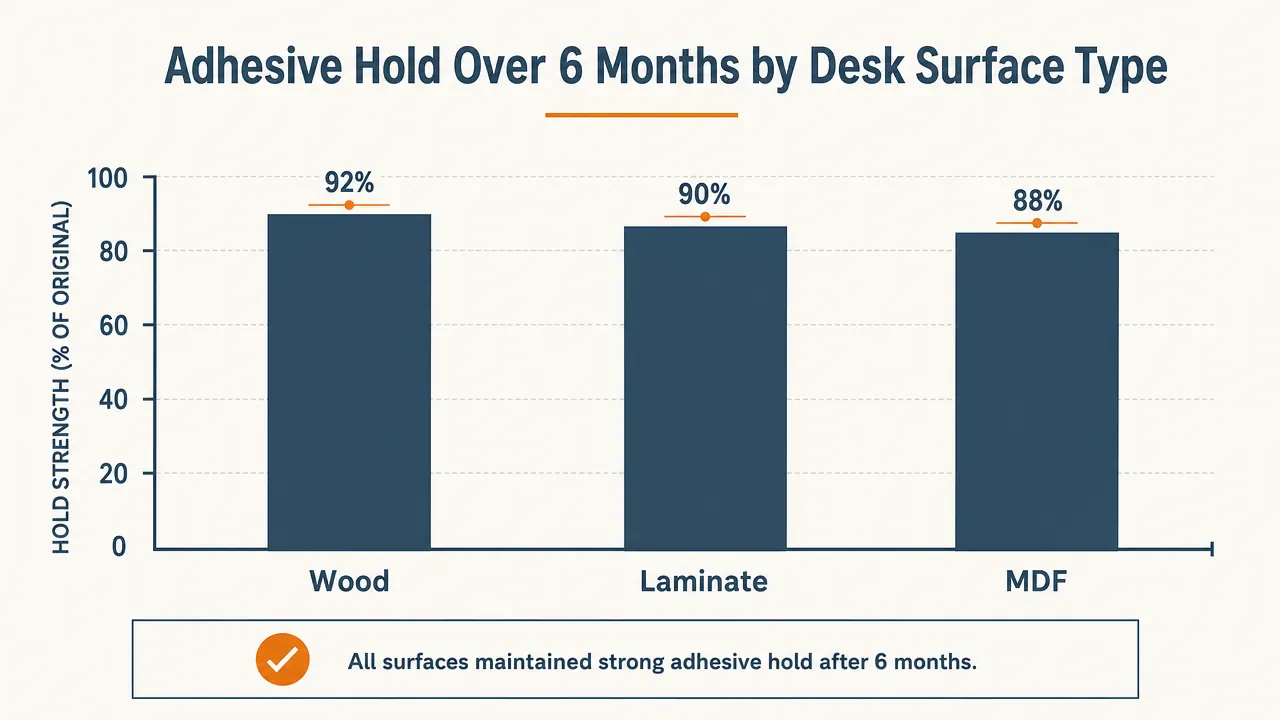
Desk Material Compatibility: What Works, What Does Not
I want to be direct about this because it is the biggest variable between someone who will love this product and someone who will regret buying it. The adhesive performs best on non-porous, smooth surfaces. In practical terms that means: laminate-top desks (the most common kind sold on Amazon and at IKEA), glass desks, solid wood desks with a polyurethane or lacquer finish, painted MDF, and powder-coated steel.
The adhesive struggles on: raw or lightly sanded wood with no sealer, highly textured melamine (the kind that feels almost like fine sandpaper), and any surface that has been cleaned recently with an oily or silicone-based spray. If you cleaned your desk with furniture polish before mounting this tray, wipe it down first with a dry microfiber cloth and wait a few minutes before applying. Oil residue on the surface is probably the number one cause of early adhesive failure based on what I see in the Amazon review complaints.
I also want to mention particleboard specifically. A lot of home office desks, especially budget ones, are particleboard with a thin paper or plastic wrap. The wrap can peel away from the particleboard over time, and if the adhesive bond is stronger than the wrap-to-board bond you can end up peeling the desk surface along with the tray. I have not had this happen on my VIVO desk, which has a well-bonded laminate top, but it is worth knowing if your desk is a very inexpensive model.
How It Held Up Over Six Months
Beyond the adhesive question, the tray itself has held up fine. The plastic basket has not cracked, warped, or discolored. The mesh design has not accumulated any significant dust buildup, which I was slightly worried about since the underside of a desk is not exactly in the cleaning rotation. I wipe it down maybe once a month when I dust the rest of the desk and it takes about ten seconds with a dry cloth.
The one thing I have noticed is that the plastic does flex slightly if you press on the center of the basket with meaningful force. This matters if you are the kind of person who, say, likes to route cables by pressing them into the tray rather than lowering them in gently from above. The flex is not alarming but the material is clearly on the lighter end. I treat it a little carefully when I am adjusting cables and I have had no issues. If you are rougher with your equipment this might be something to keep in mind.
Color fade has not been noticeable. I have the black version and it still looks the same shade as when I unboxed it. A white version would likely show dust buildup more quickly but I have not tested that colorway. For anyone curious about whether managing your cables this way connects to broader desk focus benefits, I wrote about the productivity angle in 10 reasons cleaning up desk cables boosts focus.
What I Liked
- Adhesive holds reliably on smooth laminate and finished wood surfaces for six or more months without any sign of loosening
- Fits a standard 6-outlet surge protector with room to spare, plus several routed cables alongside it
- Installs in under five minutes with no tools, no drilling, and no damage to the desk surface
- Mesh basket design lets cables enter and exit from multiple angles rather than through a single channel
- Stays put through sit-stand cycling and even desk relocation, at least on smooth surfaces
- Under $35 at current pricing, which makes it one of the least expensive ways to solve a genuinely annoying daily problem
Where It Falls Short
- Adhesive performance varies significantly by surface texture; rough or porous desk undersides may not hold reliably
- Plastic basket flexes slightly under pressure, which feels a little cheap compared to metal alternatives
- Will not fit surge protectors longer than roughly 13 inches without overhang
- Generic, no-brand packaging means no warranty or customer support if something fails
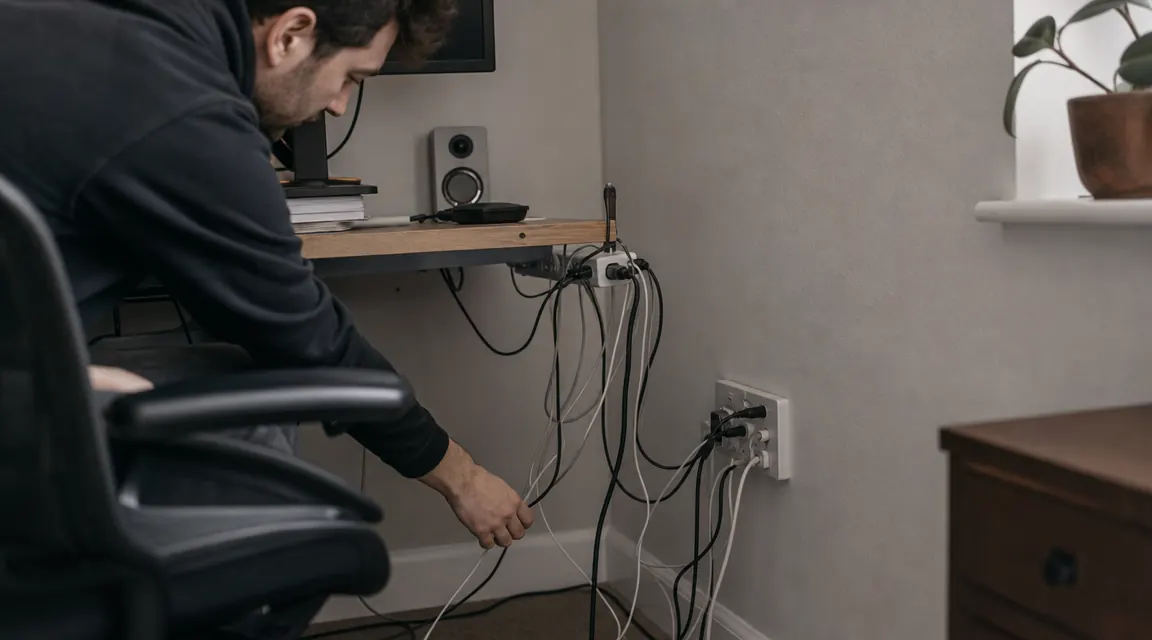
Who This Is For
This tray is made for the home office worker who has been living with visible cable clutter and keeps telling themselves they will deal with it later. If your surge protector is sitting on the floor, your cables are hanging off the desk back, and you cannot vacuum without moving a tangle of cords, this is the fastest and least invasive fix available. It is especially good for renters who cannot drill into anything, people with standing desks that have laminate or finished wood tops, and anyone setting up a new desk who wants to start with a clean layout from day one. It is also a strong option if you already use a monitor arm and have freed up desk surface but your cable situation has not caught up yet.
Who Should Skip It
If your desk has a rough, textured, or unfinished underside, the adhesive may not give you the long-term reliability you are hoping for. In that case, a screw-mounted tray or a floor-level cable box will be more dependable. Skip it also if you need to organize a large power strip longer than 13 inches, or if you are running a more complex setup with multiple monitors, a desktop tower, and several peripherals all requiring heavy cabling. This tray manages a moderate cable load well. For heavier loads, you would be better served by a wider, screw-mounted cable raceway or a dedicated cable spine that runs the full length of the desk.
Six months in, I would buy this again without hesitating.
If you have a smooth-top desk and want cables off the floor in five minutes with no tools, this tray does exactly that. Check the current price on Amazon and see if it fits your setup.
Amazon Check Today's Price on Amazon →